










COMBAT AT PRINGLE'S CREEK
by Neal Collier
from
A Sawmill Scrapbook Volume 1
Published by The Alger-Sullivan Historical Society, Inc.
Copyright 1991


Pringle's Creek is shown on some maps, but it is hardly ever identified by name. Do you know Pringle's Creek? Traveling south from Century on Highway 29, beyond the new firehouse, before Bluff Springs and Byrneville roads, there is a small stream. There is no bridge, just a culvert. After you cross it, there is a brick home on the right and a mobile home on the left. It was at this creek that the Battle of Bluff Springs took place. Most folks have heard only that it happened and that treasure hunters make a nuisance searching for souvenirs.

In 1862, the city of Pensacola was surrendered to Union forces. Most of the Confederate troops were withdrawn to more important fronts leaving small contingents at Pollard and Bluff Springs. Still, Johnny Reb pretty much had free range in the area. The Spanish Consul in Pensacola always had copies of the Montgomery newspaper, seldom more than two days old. The papers were brought to Pollard via the Montgomery and Mobile Railroad and, from there, on horseback to the
Consulate. Mind you, this was done under
cover of darkness and on roads worse than
my driveway! But, it is the little things that
count when trying to irritate an enemy.

In the Spring of 1865, a Union force of 25
thousand (the Confederate estimate) or so
began a push from Pensacola to
Montgomery. The soldiers were about equal
in number of both white and black races.

The trip would be long and hard on bad roads
made worse by the heavy spring rains, but they had a good start. The brass bands of the 76th Illinois and 24th Indiana struck up some inspiring marching music. They made about three miles that first day! Inspections were made and excess gear was abandoned to make the going easier and on the third day, March 23rd, the faster elements were approaching Pine Barren Creek. The bridge was gone and the creek was swollen to 300 feet wide. The road was a mess and Confederate pickets periodically made a nuisance by firing a few shots as they watched the Yankee invaders advance. A new bridge was built in the next day while the long downhill stretch was corduroyed (paved with logs) to support the weight of the wagons. Don't you know the Confederate pickets got a chuckle watching those Yankee wagons sliding down the hill, trying to stay between the trees and hit the bridge at the bottom of that terrifying run!

On the 25th, the Yankee troops struck out at dawn, starting the day with a skirmish at Cotton Creek. They reached Mitchell's creek at about 9 a.m. that morning. Watson's store wasn't there in those days and so they had to forego a stop for refreshments. Just as well, though, because Confederate Colonel Charles Ball and some 400 cavalry troops were dug in on the north side of the creek. The thousands of Yankee troops
quickly convinced Colonel Bail that he
should pull back and enlist the reserve
brigade of General Clanton, who was
stationed at Pollard.

Colonel Ball's men pulled back to Canoe
Creek where another skirmish took
place. They pulled back to Pringle's
Creek and waited. They waited for the
hated Yankees and for their own
reinforcements to arrive from Pollard.

The Battle of Bluff Springs (recorded as the Battle of Pine Barren in Union General Andrews' journal) was about to begin.

The Pensacola Road crossed Pringle's Creek about a mile upstream of the village of Bluff Springs. The village had been co-founded by Jesse Pritchett, Samuel Johnson, and former Ohioian John Williamson Crary just before the War Between the States began. They named it for the tall bluffs along the Escambia River and the bubbling springs which flowed there. The land was purchased and surveyed. Streets and lots were laid out and the partners dreamed of what their wonderful little town could become. But, talk about bad timing! Only a few homesteads had been built when the war broke out. Soldiers of the Confederate Army camped along the bluffs and in a few old log cabins.

Three hundred yards upstream of the ford was Prichard's Mill. The small grist mill was run from a mill pond of several acres. Today, from the air, newer ponds are seen along with the outline of the original mill pond. I have been told by some that they have seen the ruins of the old mill site while playing in the woods as boys. They didn't know what it was. Maybe somebody knows more about Prichard's Mill.

The northern bank of the creek continues up a hill which was covered mostly with pine and some hardwood. There was a fair amount of foliage and some open fields. A split-rail fence ran along the ridge. Behind the fence, the Confederates lay in wait, waiting for the Union troops and their own reinforcements. Although the Yankees' tens of thousands were scattered along the road for miles, the advance column was sufficiently strong to begin pushing the few hundred Confederates back. The sensible thing was to retreat, but just as the order was given, General Clanton's brigade arrived and the fight continued.
(continued on next page)

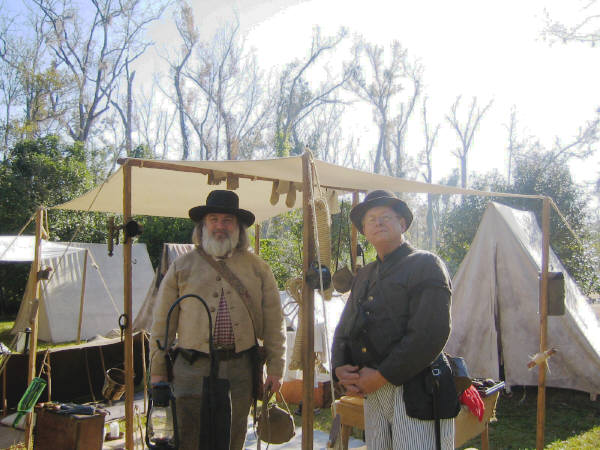
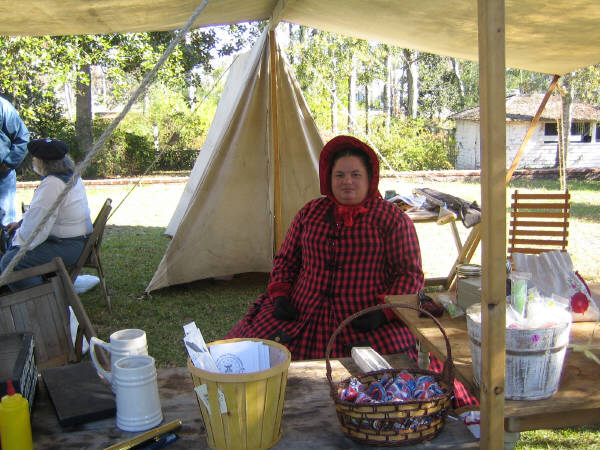
Reenactors at a Sawmill Day, early 1990s
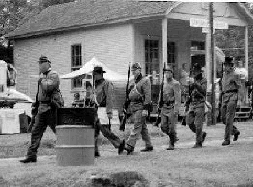
Reenactors marching past Post Office Museum
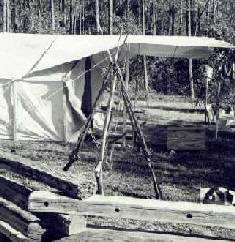
Reenactors' guns stacked in camp

This page last modified on Sunday, March 27, 2005

Boxcar Barbeque 11 25 06
Click image to enlarge
Box car barbeque 11 25 06
Click image to enlarge