Construction of the mill began in 1901. It would be January 1902, before the first logs were cut. During this construction period, the mill encountered a problem finding trained labor. Edward Hauss writes that he was "unable to get forces together." The labor problem created concerns for safety during the mill's construction. Mr. Hauss informed General Alger "with regrets that a Negro was killed. He fell along the tracks while coupling cars."

Normally, mill towns were designed on a small scale. The owners would project a life expectancy based on the amount of timberland in the area and the demand. However, the Century mill was to be a giant enterprise from conception. According to the Alger-Sullivan papers, the Century mill was to be in operation fifteen years, however, great care was taken to develop a permanent town. By 1902 the community had a commissary store, a church, a hotel, a post office, a hospital and a library. The mill provided all of these facilities to its blacks and whites.

There were schools for black
and white children. The mill
built the white school in 1902.
The company charged the
School Board of Public
Instruction of Escambia
County, Florida, $875.00 for
the school. Due to the lack of
money, the school board was
unable to pay the full amount.
Between 1900 and 1902, the
mill built Escambia County
School Number 110 for the
black children of Century.

Before the school's construction
classes were taught in Pilgrim Lodge
Baptist Church and in the Masonic Hall. The school was located on Highway 4, one-half mile west of Highway 29. According to the school's history--from 1902 until 1910--grades one through six were taught in the school, grades seven and eight were added between 1910 and 1920.

Just as today, graduation was a
formal affair. For the ceremony, boys
wore dark pants and white shirts and
black ties and the girls wore white
dresses (see above photo). There was
a commencement speaker to deliver
an address and certificates were given
to the graduates. If a student wanted
to continue his education, he would
attend Washington High School in
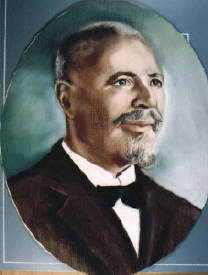
Pensacola, Florida, or Southern
Normal in Brewton, Alabama.

Gladys Hicks talked fondly of her
school days at Number 110. She
recalled that another student, Ethel
Bell Smith, used to be her protector
from the larger kids. Whenever
someone would try to bully her, Ethel was there. The school, according to Mrs. Hicks, sat high off the ground. Wooden blocks supported it and the school was so high, a small child or student could walk under the building. The students were responsible for getting firewood and girls and boys were not allowed to co-mingle.

The Black Experience in Century

SCHOOLS (1)
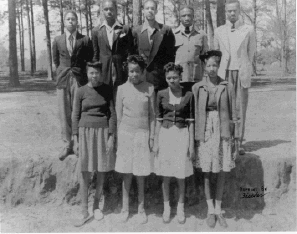
George Washington Carver Class of 1947

George Washington Carver Class of 1947
Front - Louise Hartley, Alice Robinson, ? Hardway, Ada Edward Bright
Back - Johnny Russ, Lonnie Golston, Jessie Hardy, Willie Coker, Alton Williams

Dr. James Dooley - started Southern Normal in 1911
(picture courtesy Alabama State College, Dr. Brittney-Bradley)

Dr. James Dooley - started Southern Normal in 1911

This page last modified on Wednesday, April 14, 2004

Next page